Yesterday I had to spend some time listening to new PhD students presenting their first-year work. It's part of the job: not only to figure out whether they are making a good start, but also to see if they need advice about presentation skills. And we do a fair amount of presenting ourselves: one-hour lectures two or three or six times a week, speaking in ten-minute slots at big conferences, presenting research talks, advocating cases for research grant applications, fifty minutes to persuade sixth-formers and their parents that our department is a good place in which to learn, five-minute sudden-death presentations in the department (one of the tallest toughest meanest professors there to chair the session, counting down the last 10 seconds on his fingers, and boy are you in in a whole new world of trouble if you over-run). And for me, once each year, the closest I get to stand-up comedy; a presentation to a cohort of 80 statistics PhD students on "How not to give a presentation". First time I gave it, the most distinguished statistician I know told me afterwards how he had heard "it had gone badly." I smiled and said "yes, very badly." He smiled too. "You must do it again next year, but make it even worse."
You could almost say, we talk for our living (if you miss out all the other stuff that comes across our desks, but that's a story for another time). It's not just teaching. I don't think any talking is "just teaching", even teaching itself. There's always elements of crowd control, persuasion, stand-up, oratory as well; it's just the proportions that vary.
And we tell our students: you can learn a lot from a good presentation, because the information flows freely. But you can also learn from a bad presentation; figure out what is going wrong, and ask yourself whether you do it too.
Why are presentations important to us mathematicians? Apart from the obvious cases (when one has to persuade, or to advocate), we know there is another vital point. You don't learn how to do sums by just sitting there and listening; you have to do them yourself on your own so that the answers become part of you. And you don't really know you can do them yourself until you can get up in front of friends and explain how the sums get to be done. In the talking is the doing and the learning as well.
Over the years, I've come to the conclusion that quite a lot of academic talking could be done better. It isn't that the talking is bad as such; but things get in the way. The speaker doesn't look at the audience; or they start with an apology ("so if you are beginning with an apology then why waste my time by starting at all?"); or they speak too quietly, or too monotonously, or they use jargon inappropriately; or they run over time (curiously, the very worst people for over-running are the mathematical cosmologists - almost as if they've spent so long thinking about the life-span of the universe that they've lost all sense of human-scale time). Consequently it's good to coach early PhD students in presentation skills; in the long-term that might be the single best thing one does for science and for humanity.
So I thought long and hard when I had the opportunity to talk to almost all UK statistics PhD students on presentation skills. Some people think the way to get people to give good presentations is to give them a template, a list of rules as to what to do, and a course on the use of powerpoint. Good practice has its place, but one should keep it firmly under control. In the end an effective presentation, whether it's a lecture, or a sales pitch, or advocacy, or a sermon, whatever it is, it is ultimately about you the presenter, relating to them the hearers, and it's about your personal integrity concerning the subject on which you seek to speak. And each one of these three factors changes from occasion to occasion, and always it depends on you and your personal integrity. So there can't be any general rules on how to do it well; it all depends, it's all individual, it's all very very personal.
On the other hand one certainly can set down ways in which to do the job badly. So I decided the best way to convey presentation skills to the PhD students was by way of an awful example; a session within which I would pack as many ways of going wrong as I could, break as many rules as I could think of. I reckoned I broke twenty discrete rules. At the end of the session, when everyone had stopped laughing, I invited the audience to list as many of these as they could manage. We stopped counting at thirty ...
And maybe if each of those 80 students learns as a result to save 5 minutes in the hour of presentation time, and gives 2000 presentations overall, to average audiences of 30 people, then each of my stand-up comedy routines will save about 45 person-years of time. Each time I make a fool of myself that way, allowing for sleep-periods, I've saved the equivalent of a human life. Not bad for 60 minutes of idiocy.
So you'll be wondering what this has to do with wardening, or with church. Have another read. Just about everything I've said is relevant to preaching - which also mixes persuasion with teaching and which is also deeply personal and all about integrity. And Christian truth is just like mathematics; You don't learn it by just sitting there and listening; you have to do it yourself on your own so that the truth becomes part of you. And you don't really know you can do it yourself until you can get up in front of friends and explain how the truth works out for you. I'm not saying every Christian needs to be a preacher - there are many different ways of explaining how the truth works for you. But in the talking is the doing and the learning as well.
Tuesday, 28 September 2010


Saturday, 18 September 2010
Straight from my Facebook status
Wilfrid Kendall met an Anglican chaplain today (true story).
Me: If you've visited Holy Trinity Coventry then you may have met my wife.Ch:
Me: Her name is Catherine.
Ch: Oh I did meet someone called Catherine. She told me she was from Guiseley.
Me: That's her!
MORAL: "Never ask a man if he comes from Yorkshire. If he does, he will tell you. If he does not, why humiliate him?" - that lovely man, Canon Sydney Smith

The argument room
By way of introduction, here is one of my favourite Monty Python sketches:
When I became chair of Warwick Statistics, more than ten years back, I had to learn fast in a hands-on-way about dealing with people. This, you must realize, is a difficult task for an abstract mathematician, more comfortable with α-β-γ than with real characters. But when you've got to learn, you've got to learn. Over the course of my three-year stint as chair the truth gradually dawned on me; the people I should treasure, the ones I should nurture and value above all else, were not necessarily the people who agreed with everything I said. No, the ones who taught me how to be a better head of department, who protected me from my mistakes, who brought out my very best, were the ones who disagreed with me, the ones who brought me the bad news, the ones who always looked on the dark side. They gave me the full three-dimensional view of reality. Charged as I was with the responsibility of growing and protecting my beloved department, they became some of my most important and valued assets.
Obvious lessons here for a church warden clambering up the learning curve! If I want to serve my church and my Lord as well as I can, then I need to be open to the people who don't think like me, the people who value parts of church life that I don't really get, the people whose definition of Christian discipleship may have only a very small overlap with mine. And in order for that openness to happen, I have to show I am listening to them; I have to concentrate hard to try to see things from their point of view; I have to communicate to them, without pretense or manipulation, how I respect them and I respect their position. It isn't automatically easy for someone who has spent all their life in the astringent cut-and-thrust of mathematical debate, but it's the only way.
It was some comfort to learn, a couple of years after I ended my term as chair of Warwick Statistics, that a fictional president of the United States and his chief-of-staff took a rather similar view:
"The President likes to hear from smart people who disagree with him."
Obvious lessons here for a church warden clambering up the learning curve! If I want to serve my church and my Lord as well as I can, then I need to be open to the people who don't think like me, the people who value parts of church life that I don't really get, the people whose definition of Christian discipleship may have only a very small overlap with mine. And in order for that openness to happen, I have to show I am listening to them; I have to concentrate hard to try to see things from their point of view; I have to communicate to them, without pretense or manipulation, how I respect them and I respect their position. It isn't automatically easy for someone who has spent all their life in the astringent cut-and-thrust of mathematical debate, but it's the only way.
It was some comfort to learn, a couple of years after I ended my term as chair of Warwick Statistics, that a fictional president of the United States and his chief-of-staff took a rather similar view:
"The President likes to hear from smart people who disagree with him."
Sunday, 12 September 2010
So what does a churchwarden DO?
So what does a churchwarden do? That question has been hovering around in my little black churchwarden's notebook since I started this job. Wikipedia starts helpfully: "Churchwarden: This article is about lay office. For smoking pipe, see Churchwarden pipe". The hyperlink continues, "They have the added benefit of keeping the user's face further away from the heat and smoke". Clearly there is a deep truth concealed therein.
It appears that the office of churchwarden dates way back to the 14th century, perhaps originally concerned with keeping animals out of the church (hence the long stave of office), and generally tasked with maintaining good order in the churchyard and the church, and having a care for the church fabric.
Unsurprisingly, the role has developed somewhat over the centuries.
These days at Holy Trinity Coventry the churchwardens are most visible as people who stand at the back of church[*] in a major service, and who occasionally process up to the front with their staves, leading a small column of people carrying the bread and wine, and the offertory. Early in this blog I've written about what it feels like to be performing this role, very much in the public eye, observed by up to a score of previous churchwardens who will know if one puts a foot wrong. Fortunately they are a forgiving lot, who have not forgotten what it feels like to be up at the sharp end all on one's own.
But in reality being that kind of public monument is a very small part of the job. In practice one is part of a group of four (the full complement of wardens at Holy Trinity Coventry) working in a team with the treasurer, the parish secretary, the vicar and the curate, and several others. There are legal responsibilities, and trusteeships of charities, and specialist roles for each of the four wardens, but perhaps the main task is to try to understand what is happening in the wide and complicated world of Holy Trinity, and collectively to seek to contribute towards the end of making it all run together smoothly and well. So this weekend, for example, I've been doorman at our beautiful parish centre for Coventry Heritage Weekend, helping make it available to the people of Coventry so that they can see it and learn about its history through a guided tour; I've stood at the back of Play for Pakistan and applauded players of horns and oboes and musical saws; discussed practical issues of minor building works; counted money (and checked, and re-checked, and got a fellow-warden to check my checking); and been teased mercilessly by my friends on the sound-desk because I wear a suit when doing the warden bit. (I find the suit helps. Don't ask me to explain why; I've never needed to wear a suit for anything else; it probably is something strange and personal, but it works for me.) Fortunately for my bad memory, if there is a face in the congregation that I don't know then I can ask the verger, or the congregation leader (I think we are calling them congregation lay pastors now). Usually if there is a job to be done then there is a person who is doing the job, so my first thought should be to figure out who is that person, and how to smile and say thank you to them.
So what's the big task for a churchwarden today? My current best working description for myself is, I watch. I am there to watch out to see that things work together, and to try to help when they don't. I am there to try to look ahead to guess how things might develop in the future, and what we should be doing now to get ready. That can be prosaic (when should we start thinking about the next Coventry Heritage Weekend so as to be ready when the Council asks what we are going to do?), or challenging (every year people finish their terms on our vital Parochial Church Council; so isn't it already a good time for our church people generally to begin to think about who might best replace them?). In the end, as always, it's all about people,
 and their Maker,
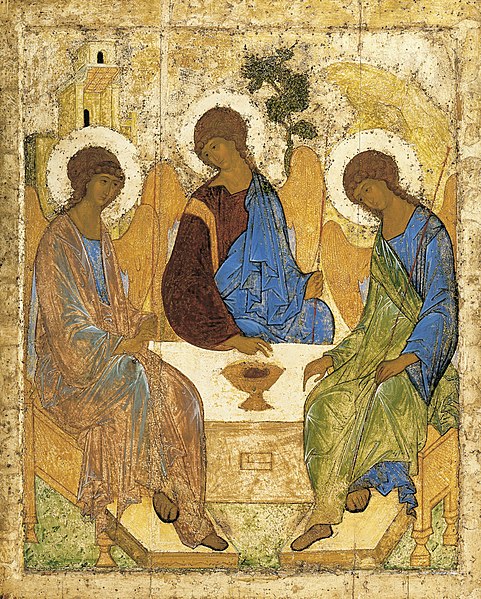 who (as was pointed out in the sermon this morning) is always several steps ahead of us ...
[*] I mentioned the back of the church. But in a cinema this would be thought of as "front of house". What Would Jesus Say? perhaps our usual terminology for churches is all back-to-front!

It appears that the office of churchwarden dates way back to the 14th century, perhaps originally concerned with keeping animals out of the church (hence the long stave of office), and generally tasked with maintaining good order in the churchyard and the church, and having a care for the church fabric.
Unsurprisingly, the role has developed somewhat over the centuries.
These days at Holy Trinity Coventry the churchwardens are most visible as people who stand at the back of church[*] in a major service, and who occasionally process up to the front with their staves, leading a small column of people carrying the bread and wine, and the offertory. Early in this blog I've written about what it feels like to be performing this role, very much in the public eye, observed by up to a score of previous churchwardens who will know if one puts a foot wrong. Fortunately they are a forgiving lot, who have not forgotten what it feels like to be up at the sharp end all on one's own.
But in reality being that kind of public monument is a very small part of the job. In practice one is part of a group of four (the full complement of wardens at Holy Trinity Coventry) working in a team with the treasurer, the parish secretary, the vicar and the curate, and several others. There are legal responsibilities, and trusteeships of charities, and specialist roles for each of the four wardens, but perhaps the main task is to try to understand what is happening in the wide and complicated world of Holy Trinity, and collectively to seek to contribute towards the end of making it all run together smoothly and well. So this weekend, for example, I've been doorman at our beautiful parish centre for Coventry Heritage Weekend, helping make it available to the people of Coventry so that they can see it and learn about its history through a guided tour; I've stood at the back of Play for Pakistan and applauded players of horns and oboes and musical saws; discussed practical issues of minor building works; counted money (and checked, and re-checked, and got a fellow-warden to check my checking); and been teased mercilessly by my friends on the sound-desk because I wear a suit when doing the warden bit. (I find the suit helps. Don't ask me to explain why; I've never needed to wear a suit for anything else; it probably is something strange and personal, but it works for me.) Fortunately for my bad memory, if there is a face in the congregation that I don't know then I can ask the verger, or the congregation leader (I think we are calling them congregation lay pastors now). Usually if there is a job to be done then there is a person who is doing the job, so my first thought should be to figure out who is that person, and how to smile and say thank you to them.
So what's the big task for a churchwarden today? My current best working description for myself is, I watch. I am there to watch out to see that things work together, and to try to help when they don't. I am there to try to look ahead to guess how things might develop in the future, and what we should be doing now to get ready. That can be prosaic (when should we start thinking about the next Coventry Heritage Weekend so as to be ready when the Council asks what we are going to do?), or challenging (every year people finish their terms on our vital Parochial Church Council; so isn't it already a good time for our church people generally to begin to think about who might best replace them?). In the end, as always, it's all about people,
[*] I mentioned the back of the church. But in a cinema this would be thought of as "front of house". What Would Jesus Say? perhaps our usual terminology for churches is all back-to-front!
Subscribe to:
Posts (Atom)